
Overview
A retail business with stores spread across a country depends on one thing above all: every till, every stock movement and every price change must reach the central systems quickly and accurately. When billing and inventory data lag behind reality, stock counts drift, financial reports are delayed, and the end-of-day close becomes a manual exercise.
This application note describes how ChiefNET SD-WAN connects stores, headquarters, data centres and cloud-hosted applications into a single private network. It covers real-time transaction sync, bulk end-of-day reconciliation, and support for the custom and packaged applications that retailers run, using a common example: SAP applications hosted in Microsoft Azure.
The Challenge
Consider a retail chain with 120 stores, a headquarters with its own server room, and an ERP platform running in a public cloud. Each store has a broadband connection, and some have a 4G backup. The IT team is small and cannot visit stores for routine network work.
The typical problems are:
- Out-of-date inventory. Stock levels at headquarters do not match the shelves because store updates are delayed or fail silently, leading to stock-outs and over-ordering.
- Delayed billing data. Sales figures arrive late, which delays financial reporting and complicates promotions and pricing decisions.
- Slow end-of-day reconciliation. The nightly audit and resync of billing, sales and inventory moves large volumes of data. On a congested or unreliable link it runs late or must be restarted.
- Mixed application locations. Some applications run at headquarters, some in a data centre, and some in the cloud. Each new location has traditionally meant a new VPN, a new set of firewall rules and more manual routing.
- Shared links. Point-of-sale traffic competes with software updates, video streaming and general browsing on the same store connection.
The ChiefNET Solution
ChiefNET places one pre-provisioned CPE at each location and connects all of them through the ChiefNET Cloud WAN. Configuration, monitoring and policy are managed centrally from the ChiefNET Orchestrator.
Real-time inventory and billing sync
Each store’s CN-4 appliance builds encrypted tunnels to the ChiefNET Cloud WAN as soon as it is powered on and connected to the Internet. Tunnel traffic is encrypted with AES-256, and each CPE authenticates with its own X.509 certificate. Dynamic routing is preconfigured, so store LAN subnets are learned automatically and every store can reach headquarters, the data centre and the cloud without manual route configuration.
Because the network is always on, transactions and stock movements are posted to the central database as they happen, rather than in batches when a link is available. Administrators can also configure ping-latency monitoring from a store CPE to a specific host, such as the central billing database, so that slow responses raise an alert before staff notice them.
End-of-day reconciliation
At the close of business, stores audit and resync billing, sales and inventory figures with headquarters. This is a bulk transfer, so throughput matters. The CN-4 supports up to 800 Mbps of VPN throughput, giving enough headroom for large reconciliation jobs while day-time transactional traffic continues.
ChiefNET’s QoS engine keeps both workloads healthy. Real-time and latency-sensitive flows, such as card-payment and POS traffic, can use a real-time profile, while reconciliation traffic receives a guaranteed minimum bandwidth and a maximum limit so that it finishes on time without starving other traffic. Traffic with no explicit policy is fair-queued, so no single flow can take over the link.
Supporting custom and cloud applications
Many retailers and wholesalers run custom applications built around their own processes, alongside packaged ERP. Some are hosted at headquarters, some in a data centre and some in the cloud. ChiefNET supports each of these locations with the appropriate CPE model:
- CN-VM-1, a virtual CPE for VMware or KVM in a data centre or headquarters server room.
- CN-Cloud-1, a cloud CPE that runs inside a VPC or VNET on AWS, Azure, GCP or DigitalOcean.
For example, many organisations run SAP databases and applications in Azure. Stores need access to both headquarters and the Azure VNET with dependable quality of service. A CN-Cloud-1 instance in the VNET joins the same Cloud WAN as the stores. On each store CPE, a traffic policy identifies SAP traffic by destination subnet, port or application domain and applies a minimum-bandwidth QoS profile, so SAP sessions remain responsive even when the store link is busy.
Split-horizon DNS makes sure that internal host names, such as the SAP database server, are resolved only by the organisation’s own DNS servers and never leaked to the ISP.
Local Internet breakout and store security
Not all store traffic belongs on the enterprise network. With Local Internet Breakout, traffic to SaaS services such as Microsoft 365 goes directly to the Internet from the store, while POS, inventory and ERP traffic stays inside the encrypted tunnels. This reduces latency for cloud applications and keeps tunnel capacity for business-critical traffic.
POS terminals and other systems that have no reason to reach the Internet can be restricted to the enterprise network only. DNS filtering with curated blocklists (malware, phishing, trackers and other categories) is applied to every store, and unwanted applications can be blocked or rate-limited. The CPE has no open ports on its WAN interfaces; it only makes outbound connections.
Dual links and failover
Where a store has two connections, the CPE monitors each link for packet loss, latency and jitter and fails over automatically when a configured threshold is crossed. Traffic can also be load-balanced across both links, with per-flow balancing that avoids packet reordering. If the backup is a metered 4G link, it can be reserved for POS and inventory traffic only.
Reference Architecture
The diagram shows a set of stores, each with a CN-4, connected over encrypted tunnels to the ChiefNET Cloud WAN. A CN-VM-1 at the headquarters data centre hosts the billing and inventory database, and a CN-Cloud-1 in an Azure VNET serves SAP applications with guaranteed-bandwidth QoS. SaaS traffic leaves each store directly through local breakout, and all devices are managed from the ChiefNET Orchestrator.
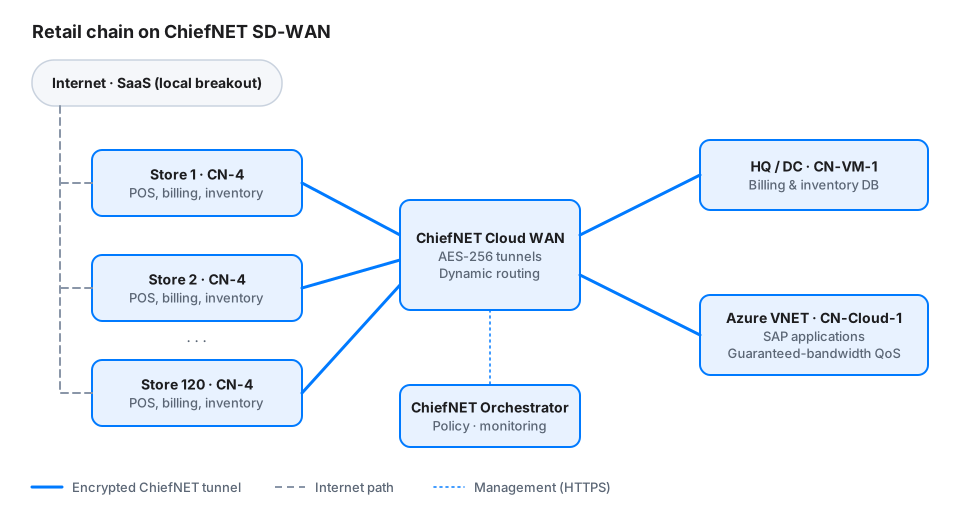
Stores with CN-4 CPEs reach the HQ data centre and SAP in an Azure VNET over ChiefNET Cloud WAN, while SaaS traffic breaks out locally.
Key Benefits
- Accurate, current data. Sales and stock changes reach central systems as they happen, reducing discrepancies and manual correction.
- Faster close of business. High tunnel throughput and bandwidth guarantees let end-of-day reconciliation finish on schedule.
- One network for every application location. Headquarters, data centre and cloud applications are reached over the same Cloud WAN, using physical, virtual or cloud CPEs.
- Predictable application performance. QoS profiles protect POS, SAP and reconciliation traffic from general browsing and updates.
- Simple rollout. Pre-provisioned CPEs need only power and cables at the store; no skilled staff are needed on site.
- Room to grow. New stores and new cloud regions are added from the Orchestrator without redesigning the network.
Capability Map
| ChiefNET capability | How it is used here |
|---|---|
| ChiefNET Cloud WAN with dynamic routing | Connects all stores, headquarters and cloud VNETs with automatic route learning |
| AES-256 encrypted tunnels with per-device certificates | Protects billing, card and inventory data in transit |
| Hierarchical QoS (real-time, minimum and maximum bandwidth) | Prioritises POS, guarantees bandwidth for SAP and reconciliation, limits non-business traffic |
| CN-VM-1 and CN-Cloud-1 | Brings the data centre and the Azure VNET into the same network |
| Local Internet Breakout | Sends Microsoft 365 and other SaaS traffic directly to the Internet from each store |
| Split-horizon DNS | Keeps internal host names, such as the SAP database server, private |
| DNS filtering and application control | Blocks malicious and unwanted domains across all stores |
| Ping-latency monitoring and alerts | Warns when the path from a store to the central database degrades |
Deployment Summary
- List store, headquarters, data centre and cloud locations, and identify the key applications and their servers.
- Order CN-4 appliances for stores and deploy CN-VM-1 and CN-Cloud-1 instances for the data centre and Azure VNET.
- Pre-provision devices and policies in the ChiefNET Orchestrator, including SAP and reconciliation QoS profiles, breakout rules and DNS filtering.
- Ship CPEs to stores; local staff connect power, the ISP link and the LAN.
- Confirm each device is online, verify routing to headquarters and Azure, and enable latency alerts for critical servers.
Conclusion
Retail operations depend on timely data from every store. ChiefNET SD-WAN gives each location a secure, always-on path to headquarters and the cloud, with the bandwidth controls needed for both real-time transactions and bulk reconciliation. Because the same platform covers physical stores, data centres and cloud VNETs, retailers can support packaged and custom applications alike, and add stores or applications without adding complexity.