Manufacturing · Process · Utilities
Securing Industrial Control Systems
Stream PLC, DCS, SCADA and historian data to MES, analytics and the cloud while making it physically impossible for anything to flow back into the plant.

ChiefNET OT Shield · Unidirectional OT/ICS gateway
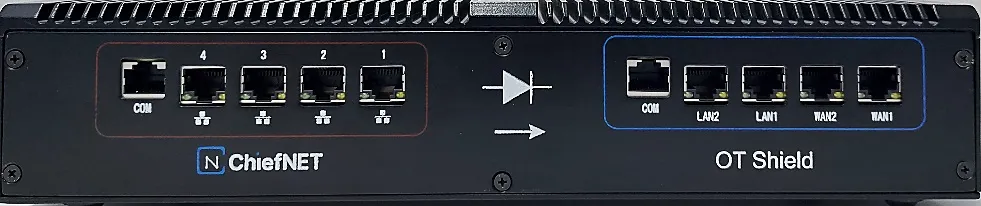
OT Shield is a cybersecurity device with hardware-enforced data diode technology. It delivers real-time OT and ICS data to IT, monitoring centres and the cloud, while keeping critical production systems physically unreachable from outside.
Why a data diode
Plants, grids and defence systems need real-time monitoring, yet every connection to IT widens the path an attacker can use to reach the control system. Firewalls and VPNs depend on software rules, patches and credentials, and one mistake reopens the door.
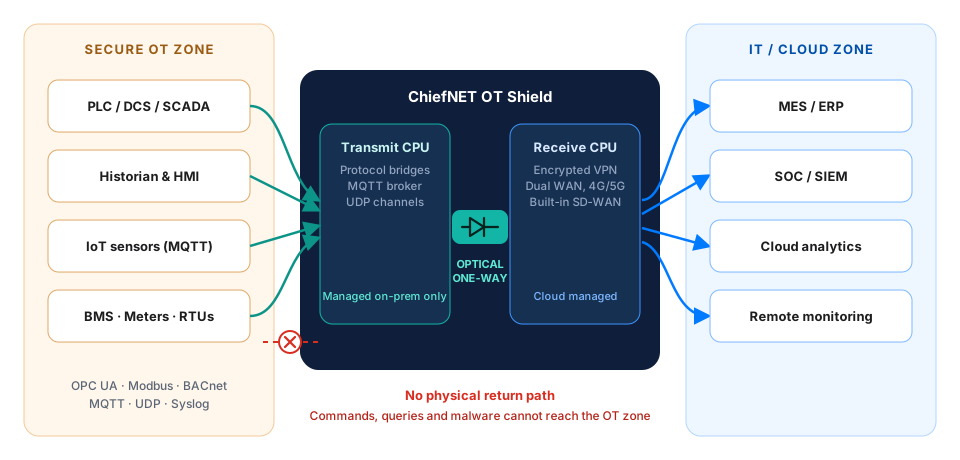
A data diode removes the door. OT Shield has a transmitter on the secure side and a receiver on the less secure side, joined only by an optical one-way link. With no physical connection for data to flow back, the protected network stays isolated even if the IT side is compromised, and operations can continue while IT is down.
Key features
Two isolated CPUs joined by an optical one-way interface. The air gap is physical, so data cannot flow in the wrong direction.
There is no IP stack, firewall rule or software on the return path that an attacker could misconfigure or compromise.
Real-time OT/ICS data leaves the receive CPU over an encrypted VPN tunnel to the data centre, monitoring centre or cloud.
Built-in OPC UA, BACnet and Modbus bridges, an optional MQTT broker with MQTT-to-UDP gateway, and custom UDP channels.
A minimal, hardened OS reduces the attack surface. Isolation is enforced in hardware, so there is no routine patch cycle for the diode itself.
Zero-touch and pre-provisioning, whole-network monitoring, alerts and dashboards for the receive side from the ChiefNET cloud.
Redundant ISP connections (broadband, 4G, 5G) with WAN failover and load balancing for uninterrupted delivery.
Securely interconnect factories, plants and branches with the data centre or head office while keeping the OT network isolated.
Interoperable with major PLC vendors. OT Shield carries data from these industrial protocols and channels across the diode.
* TFTP requires additional software.
Regulations and standards
Regulators increasingly require OT systems to be isolated from IT. OT Shield gives you segregation you can demonstrate physically to auditors.
Requires that the communication channel and data of OT systems are isolated from IT systems, and that control of power system elements runs over a dedicated channel isolated from the Internet.
Nuclear regulatory authorities mandate data diode technology for safety-critical systems. Several other nations strongly recommend it.
Rail, air and water transport control systems must use unidirectional technology, and firewalls are not accepted between OT and IT.
Zones and conduits, unidirectional gateways at high-consequence OT/IT boundaries, and a controlled Level 3.5 boundary in the Purdue model.
Comparison
| Dimension | ChiefNET OT Shield | Traditional firewall |
|---|---|---|
| Data direction | One-way, physically enforced | Two-way, governed by software rules |
| Patch and maintenance burden | None for the isolation itself | Frequent patches, often needing outage windows |
| Misconfiguration risk | Not applicable: no rule set to misconfigure | A common cause of real-world ICS breaches |
| Resistance to remote exploitation | Near total: no reverse path exists | Moderate; depends on rule hygiene and patching |
| Fit for production-critical control systems | Purpose-built | Adequate for IT; not ideal for critical ICS |
| Audit and compliance evidence | Physically demonstrable segregation | Ongoing rule and log reviews needed |
Applications
Shield furnaces, compressors and other industrial control components from cyber intrusion.
Collect real-time SCADA data safely while blocking every external threat.
Keep classified systems insulated while sending data out for analysis and reporting.
Run diagnostics and predictive maintenance without exposing OT endpoints.
Move clinical and device data to EHR and cloud services while the hospital network stays protected.
Send transaction and log data to external systems without opening the core network.
Protect outdated but essential systems from new vulnerabilities.
Exchange data safely between geographically distributed facilities.
Industry use cases
Each document covers the industry context, reference architecture, detailed use cases, compliance alignment and deployment model. Read online or download as PDF.
Manufacturing · Process · Utilities
Stream PLC, DCS, SCADA and historian data to MES, analytics and the cloud while making it physically impossible for anything to flow back into the plant.
Generation · Transmission · Distribution
One-way, hardware-enforced export of generation, substation and SCADA data to load despatch, analytics and compliance systems, in line with CEA isolation requirements.
Defence · Military · Government
Cross-domain, one-way transfer of sensor, logistics and C2 data out of classified networks with no reverse path for intrusion or exfiltration-by-command.
Hospitals · Health Systems · Clinical
Move data from medical devices, building systems and clinical networks to EHR and analytics platforms without exposing patient-critical systems to inbound attack.
Banking · Payments · Trading
Protect core banking, payments and trading environments while exporting logs, transaction feeds and backups one-way to SOC, regulators and DR sites.
Oil & Gas · Water · Transport · and more
Ten further industry verticals and cross-functional security functions where hardware-enforced one-way transfer protects critical systems.
Specifications
| Diode interface throughput | 1 Gbps (scalable models from 100 Mbps to 1 Gbps) |
|---|---|
| Physical air gap | Optical, hardware-enforced |
| Architecture | Two CPUs (transmit and receive) isolated by an internal hardware data diode |
| Transmit CPU ports | 4 × 2.5 Gbps copper, 1 × RS-232, 2 × USB 3.0, 2 × USB 2.0, 1 × HDMI/DP |
| Receive CPU ports | 4 × 2.5 Gbps copper (2 × WAN, 2 × LAN), 1 × RS-232, 2 × USB 3.0, 2 × USB 2.0, 1 × HDMI/DP |
| Management | Transmit CPU on-premises only; receive CPU remotely via cloud orchestration |
| Operating temperature | 0 °C to 50 °C |
| Storage temperature | −20 °C to 70 °C |
| Humidity | 5% to 90% RH |
| Enclosure | Aluminium; desktop or 1U 19" rack mount |
| Dimensions | 330 × 126 × 65 mm (desktop) / 1U 19" rack mount |
| Weight | 1.3 kg to 3 kg depending on model |
| Power supply | 12 V DC / 10 A external adapter; 230 V AC on rack-mount models |
| Power consumption | 120 W max |
| Part number | Model | Description |
|---|---|---|
| CNOTS-DD-TX | OTS-FB-TX | OT Shield with data diode functionality from Tx to Rx |
| CNOTS-DD-RX | OTS-FB-RX | OT Shield with data diode functionality from Rx to Tx |
| CNOTS-DD-TX-1U | OTS-FB-TX-1U | OT Shield with data diode functionality from Tx to Rx, 19" rack mount |
| CNOTS-DD-RX-1U | OTS-FB-RX-1U | OT Shield with data diode functionality from Rx to Tx, 19" rack mount |
Hardware-enforced (optical) data diode: architecture, features, hardware specifications and ordering information.
Why hardware-enforced data diodes outperform firewalls for OT networks, and how ChiefNET OT Shield delivers one-way OT-to-IT data transfer.
We recommend starting with a site assessment and a pilot at one representative plant, substation or facility. Contact us to arrange one.