
Executive Summary
Power generation plants and electricity grids sit at the intersection of two worlds that were never designed to meet: decades-old Operational Technology (OT) built for continuous, deterministic, safety-critical operation, and modern Information Technology (IT) built for connectivity, analytics and remote access. As utilities digitise – rolling out SCADA-to-cloud dashboards, wide-area monitoring, smart metering and remote diagnostics – every new IT-to-OT connection becomes a potential entry point for intrusion, ransomware or nation-state sabotage of the grid.
ChiefNET OT Shield is a hardware-enforced data diode purpose-built to close that gap. It allows real-time operational data – SCADA tags, RTU/IED telemetry, protection relay logs, historian records, meter reads – to flow out of generation and substation OT networks into IT, cloud and control-centre systems, while making it physically impossible for any command, malware or intrusion attempt to flow back in. There is no firewall rule to misconfigure and no firmware to patch under emergency change windows; the isolation is built into the hardware itself.
This document presents a use-case-driven view of how ChiefNET OT Shield applies specifically to power generation (thermal, hydro, renewable) and grid (transmission and distribution) environments – covering reference architecture, detailed use cases, regulatory alignment, and the business case for deployment across a utility’s generation and grid asset fleet.
Industry Context: Cybersecurity Challenges in Power Generation & Grid
A Sector Under Increasing Digital Pressure
Generation plants and grid substations are being modernised at pace: digital protection relays, PMUs feeding Wide-Area Monitoring Systems (WAMS), cloud-based EMS/DMS analytics, remote condition monitoring for turbines and transformers, and smart metering infrastructure (AMI). Each of these initiatives depends on moving data out of the OT network – and in many legacy deployments, that data path is bidirectional by default, because it was built on general-purpose firewalls and VPNs rather than OT-native isolation.
A Well-Documented Threat History
The power sector has one of the clearest track records of OT-targeted cyberattacks of any industry. Coordinated malware attacks on Ukrainian distribution utilities in December 2015 caused hours-long outages affecting hundreds of thousands of customers by manipulating breaker controls remotely. A follow-on attack in 2016 used purpose-built grid-attack malware capable of speaking substation protocols directly to open breakers. These incidents demonstrated that once an attacker gains a bidirectional path into OT – even through what looked like a well-managed IT/OT boundary – the grid itself becomes the target, not just the data.
More recently, security researchers and national CERTs have continued to flag sustained reconnaissance and pre-positioning activity by advanced threat actors inside energy-sector OT networks, underscoring that the risk is persistent rather than historical.
Why General-Purpose IT Security Falls Short
-
Firewalls and VPNs are software-defined and bidirectional by design – a misconfigured rule, an unpatched CVE, or a stolen credential can open a path back into OT.
-
Patch cycles that are routine in IT are disruptive in OT, where planned maintenance windows may be months apart and unplanned downtime is unacceptable for grid-connected assets.
-
OT protocols (Modbus, DNP3, IEC 61850 GOOSE/MMS, IEC 60870-5-104) were designed for engineering reliability, not authentication or encryption, making protocol-level attacks difficult to detect with IT-centric tools.
-
Many substations and plants are unmanned or lightly staffed, so a compromise can persist for extended periods before detection.
Regulatory and Standards Drivers
Power utilities operate under some of the most explicit cybersecurity mandates of any sector, and regulators increasingly reference network segmentation and one-way data transfer as a recognised control:
-
Central Electricity Authority (CEA) Cyber Security Guidelines, India: mandate segregation of OT/ICS networks from IT and corporate networks, restricted external connectivity, and controls on data leaving control system networks for entities in the Indian power sector.
-
IEC 62443: the leading international standard for industrial automation and control system (IACS) security, which calls for network segmentation into security zones and conduits – a model that a data diode implements at the hardware level.
-
IEC 61850 / IEC 60870-5-104: substation automation and telecontrol standards whose data (event logs, measurements, GOOSE/MMS traffic) must often be exported for monitoring without exposing the substation LAN.
-
NERC CIP (for internationally benchmarked utilities): requires documented Electronic Security Perimeters and restricts external routable connectivity into BES Cyber Systems – a requirement a hardware-enforced one-way path satisfies unambiguously.
-
IT Act 2000 & Sectoral CERT advisories (India): reinforce baseline security hygiene and incident-reporting obligations for critical information infrastructure operators, including power generation and transmission entities.
ChiefNET OT Shield: Solution Overview
ChiefNET OT Shield is a purpose-built OT cybersecurity appliance combining a hardware-enforced data diode with a hardened, cloud-managed communications platform. It is designed to sit precisely at the boundary between generation/substation OT networks and the IT, cloud or control-centre systems that need visibility into them.
Core Architecture
-
Physical transmitter (TX) module on the secure OT side and a physically separate receiver (RX) module on the monitoring/IT side, joined only through an optical, one-way link.
-
No physical mechanism exists for signals to travel from the RX side back to the TX side – isolation is enforced by hardware, not by a rule set that can be disabled or bypassed.
-
A hardened operating system on both sides minimises attack surface and removes the general-purpose services that create most software vulnerabilities.
Key Capabilities Relevant to Power Generation & Grid
-
Native OT protocol support: BACnet, Modbus, MQTT, OPC UA and industrial UDP (broadcast, multicast, anycast), covering common SCADA, DCS and building/plant automation telemetry.
-
File and log transfer: UDP file transfer, Syslog and HTTP PUT for historian exports, protection relay event files, and fault recorder (COMTRADE) logs.
-
Encrypted VPN transport: data exiting the diode is carried to the monitoring centre or cloud over a hardened, encrypted tunnel, protecting confidentiality in transit without reopening a return path.
-
Dual WAN / 4G-5G failover: on the monitoring (RX) side, ensuring uninterrupted delivery of grid telemetry even where fixed-line connectivity to a substation or plant is unreliable.
-
Built-in SD-WAN functionality: for utilities with many branch or site locations, enabling secure interconnection of plants, substations and offices with the head office / data centre while keeping the OT network isolated from the IT network.
-
Centralised cloud orchestration: zero-touch and pre-provisioning, fleet-wide monitoring, alerting and dashboards – essential for utilities managing dozens or hundreds of generation and substation sites.
-
Zero patch burden: because isolation is physical rather than rule-based, there is no firewall ruleset or reverse-path exploit to patch against – reducing the outage-prone patch cycles that plague OT firewalls.
Reference Architecture for Power Generation & Grid
Single-Site Deployment – Generation Plant / Substation
At a single generation plant or substation, ChiefNET OT Shield sits between the OT zone (DCS/SCADA master, RTUs, IEDs, PMUs, protection relays, turbine and generator instrumentation) and the IT zone (utility SOC/NOC, wide-area monitoring, cloud historian, and compliance reporting systems). All operational data leaves the OT zone through the diode’s transmitter; nothing – no command, no query, no malware – can traverse back.
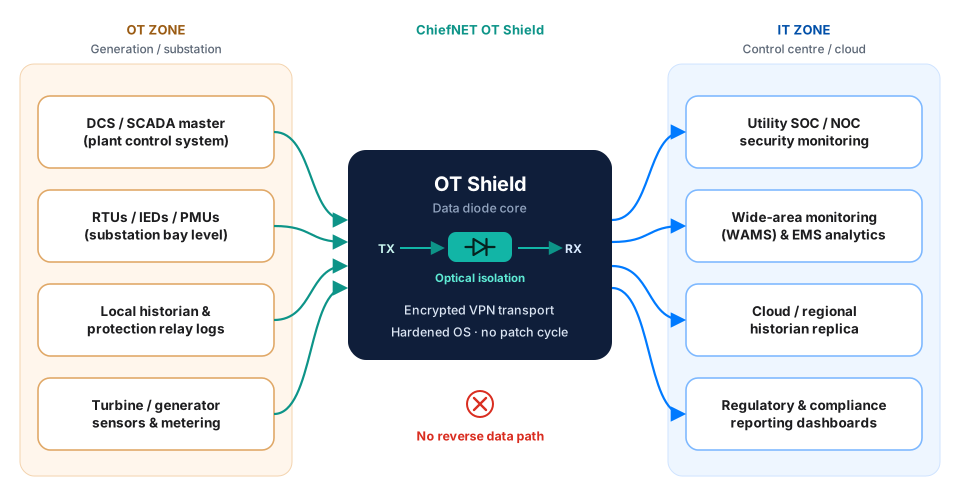
Single-site reference architecture – unidirectional OT-to-IT data flow via ChiefNET OT Shield
Fleet-Wide Deployment Across Generation & Grid Assets
Utilities typically operate many generation units and hundreds of substations across a service territory. ChiefNET OT Shield’s cloud-based orchestration platform allows one OT Shield device per site to be provisioned, monitored and managed centrally, while each site’s isolation guarantee remains entirely local and independent – a compromise or outage at one site cannot propagate to another, and the central SOC/NOC cannot inadvertently open a path back into any site.
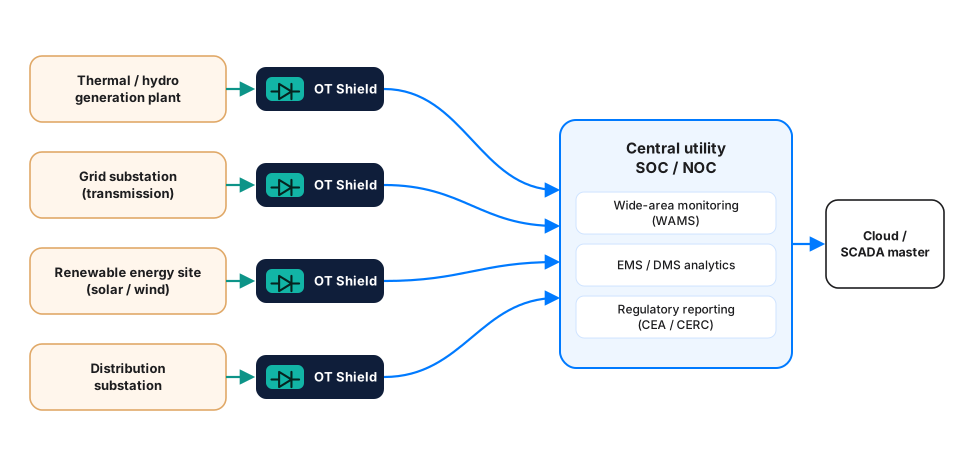
Fleet-wide deployment – multiple generation and grid sites converging on a central utility SOC/NOC
Detailed Use Cases: Power Generation & Grid
The following use cases illustrate how ChiefNET OT Shield is applied across the generation, transmission and distribution value chain – from thermal and hydro power plants through renewable energy sites to substations and the smart grid edge.
Power Plant DCS / Historian Data Replication
Thermal & Hydro Generation
- Challenge
- Plant operations, maintenance and corporate teams need real-time visibility into DCS process values, turbine performance and historian trends for reporting and predictive maintenance – but the plant DCS network must remain isolated from corporate IT to protect generation-critical control loops.
- OT Shield solution
- ChiefNET OT Shield taps the DCS historian and key SCADA points on the secure TX side and replicates them one-way to a cloud or regional historian on the IT side over an encrypted VPN, using OPC UA / Modbus / UDP protocol support – with zero possibility of any write-back to the DCS.
- Outcome
- Real-time visibility for O&M and corporate reporting without touching the control network
- Predictive maintenance analytics enabled on turbine, boiler and auxiliary data
- DCS remains fully air-gapped from any external network path
Substation RTU / IED / PMU Data Forwarding to WAMS
Transmission & Distribution Grid
- Challenge
- Wide-Area Monitoring Systems (WAMS) and Energy Management Systems (EMS) need continuous PMU and RTU telemetry from substations, but substation automation LANs (IEC 61850 GOOSE/MMS, IEC 60870-5-104) are highly sensitive to any external connectivity.
- OT Shield solution
- OT Shield forwards RTU, IED and PMU measurement streams from the substation bay and station level network to the control centre's WAMS/EMS platform through a dedicated one-way path, supporting the UDP-based and industrial protocols these devices use.
- Outcome
- Grid operators gain wide-area situational awareness without opening a route into substation automation
- Supports phasor data delivery for state estimation and stability monitoring
- Eliminates the substation as a pivot point for lateral movement towards other stations
Renewable Energy (Solar / Wind) Remote SCADA Monitoring
Renewable Generation
- Challenge
- Solar parks and wind farms are frequently unmanned and geographically dispersed, relying on remote SCADA monitoring for inverter, string and turbine performance — typically over cellular or satellite links that are attractive attack surfaces if bidirectional.
- OT Shield solution
- OT Shield, paired with its dual-WAN 4G/5G failover on the monitoring side, transmits inverter, meter and SCADA data one-way to the asset owner's or O&M contractor's central monitoring platform, keeping the remote site's control network fully isolated even over public cellular backhaul.
- Outcome
- Uninterrupted remote performance monitoring across geographically distributed sites
- Cellular/public WAN connectivity used safely without exposing site control systems
- Zero-touch provisioning simplifies rollout across large renewable portfolios
Smart Grid / AMI Head-End Data Collection
Distribution & Smart Grid
- Challenge
- Advanced Metering Infrastructure (AMI) head-end systems and Distribution Management Systems (DMS) require large volumes of meter and feeder data from the field, but distribution automation networks increasingly overlap with substation and DER control assets.
- OT Shield solution
- OT Shield isolates the distribution automation / feeder RTU layer from the AMI head-end and DMS analytics layer, allowing meter reads, outage signals and feeder telemetry to flow upstream one-way while shielding field control devices from any inbound path.
- Outcome
- Enables smart grid analytics and outage detection without expanding the attack surface
- Distribution automation devices remain isolated even as data volumes and endpoints grow
- Supports phased smart-grid rollouts without re-architecting existing field networks
Protection Relay & Fault Recorder Log Forwarding for Forensics
Transmission & Distribution Grid
- Challenge
- Protection engineers need fast access to relay event logs and COMTRADE fault records after a trip or disturbance, but relay and fault-recorder networks sit deep inside the substation's most sensitive protection zone.
- OT Shield solution
- OT Shield forwards relay event logs and fault recorder files via UDP file transfer / Syslog to a central protection engineering server, giving engineers rapid access to forensic data without any external system ever reaching the protection network.
- Outcome
- Faster fault analysis and root-cause investigation after grid disturbances
- Protection and control zone remains isolated per IEC 62443 zone/conduit principles
- Supports compliance evidence for post-event regulatory reporting
Legacy SCADA Modernisation Without Re-engineering the Control Network
Thermal, Hydro & Ageing Substations
- Challenge
- Many plants and older substations run legacy SCADA/DCS platforms that cannot be easily upgraded, yet management still wants modern dashboards, mobile visibility and cloud analytics without re-architecting or re-certifying the underlying control system.
- OT Shield solution
- OT Shield is deployed as a bolt-on data-export layer on the legacy network's existing protocols (Modbus, UDP, BACnet), giving modern IT and cloud systems a live data feed without any change, patch, or re-certification of the legacy control system itself.
- Outcome
- Digital transformation achieved without disturbing a validated, safety-critical legacy system
- No re-certification or vendor re-engineering cost for the existing SCADA/DCS
- Clear, low-risk migration path towards eventual modernisation
Regulatory Compliance & Statutory Reporting (CEA / SERC / CERC)
All Generation & Grid Segments
- Challenge
- Utilities must periodically submit generation, grid and outage data to regulators and load dispatch centres, and must also demonstrate OT/IT network segregation under CEA cybersecurity guidelines – both of which require reliable, auditable data export from OT systems.
- OT Shield solution
- OT Shield provides both the compliance evidence (a physically enforced, documented one-way boundary matching CEA/IEC 62443 zone-and-conduit requirements) and the mechanism for automated statutory data submission to regulatory and load-dispatch reporting systems.
- Outcome
- Simplifies audits by providing a hardware-verifiable segregation control, not just a policy document
- Automates recurring regulatory and load-dispatch data submissions
- Reduces audit preparation effort across multiple generation and grid sites
Secure Plant-to-Plant & Inter-Utility Data Exchange
Multi-Site Generation Fleets & Grid Operators
- Challenge
- Generation companies operating multiple plants, or grid operators exchanging data with neighbouring utilities and regional load dispatch centres, need to share operational data without creating a routable path between two separate OT environments.
- OT Shield solution
- Each site's OT Shield independently isolates its own OT network while permitting data to be aggregated and cross-shared at the IT/cloud layer, so operational visibility can be pooled centrally without ever bridging two OT networks directly.
- Outcome
- Enables fleet-wide and inter-utility data sharing without direct OT-to-OT connectivity
- Each site retains independent, physically enforced isolation
- Supports regional grid coordination and load dispatch data sharing
Compliance & Standards Alignment
The table below maps ChiefNET OT Shield capabilities to the regulatory and standards expectations most relevant to Indian and internationally benchmarked power utilities.
| Framework / Requirement | Requirement Summary | How OT Shield Addresses It |
|---|---|---|
| CEA Cyber Security Guidelines (India) | Segregate OT/ICS networks from IT and restrict external connectivity out of control system networks. | Hardware data diode enforces one-way OT-to-IT transfer; no external system can reach the control network. |
| IEC 62443 (Zones & Conduits) | Segment IACS into security zones connected by controlled conduits. | OT Shield functions as a physically-enforced conduit between zones with only one permitted direction of flow. |
| IEC 61850 / IEC 60870-5-104 | Protect substation automation and telecontrol data while enabling monitoring. | Native support for exporting substation telemetry and logs without exposing the automation LAN. |
| NERC CIP (Electronic Security Perimeter) | Restrict and document external routable connectivity into BES Cyber Systems. | Physical one-way isolation provides an auditable, hardware-verifiable perimeter control. |
| IT Act 2000 / CERT Advisories | Maintain baseline security hygiene and incident reporting for critical infrastructure. | Reduces the OT attack surface that leads to reportable incidents; simplifies evidence for audits. |
Business Value for Power Generation & Grid Operators
| Business Driver | Impact of ChiefNET OT Shield |
|---|---|
| Grid & plant reliability | Removes the most common remote-attack vector into control systems, reducing risk of intrusion-driven outages or trips. |
| Regulatory audit readiness | Provides a hardware-verifiable segregation control that is straightforward to demonstrate to CEA, SERC and internal auditors. |
| Operational cost | Eliminates recurring OT firewall patch cycles and associated planned-outage windows for rule updates. |
| Digital transformation pace | Allows cloud analytics, WAMS and remote monitoring initiatives to proceed without re-architecting or re-certifying control systems. |
| Fleet scalability | Centralised, zero-touch provisioning supports rollout across dozens to hundreds of generation and substation sites from a single management platform. |
| Incident response | Rapid, low-risk access to relay, fault-recorder and historian data speeds up root-cause analysis after grid events. |
ChiefNET OT Shield vs. Traditional OT Firewalls
In power generation and grid environments, where planned outages for patching are costly and unplanned downtime is unacceptable, the distinction between rule-based and hardware-enforced isolation is a first-order design decision.
| Dimension | ChiefNET OT Shield | Traditional Firewall |
|---|---|---|
| Data directionality | One-way, physically enforced | Two-way, governed by software rules |
| Patch / maintenance burden | None – isolation is hardware, not firmware | Frequent patching, often needing outage windows |
| Misconfiguration risk | Not applicable – no rule set to misconfigure | Common cause of real-world OT breaches |
| Resistance to remote exploitation | Near-total – no reverse path exists to exploit | Moderate; depends on rule hygiene and patch currency |
| Fit for grid-connected, safety-critical assets | Purpose-built for this class of asset | Adequate for IT; not ideal for critical OT |
| Audit / compliance evidence | Physically demonstrable segregation | Requires ongoing rule and log review to evidence |
Technical Capability Snapshot
| Capability | Specification |
|---|---|
| Throughput | Up to 1 Gbps |
| Isolation | 100% one-way, optical / hardware-enforced physical air gap |
| Software exploit surface on reverse path | Zero – no reverse channel exists |
| OT protocols supported | BACnet, Modbus, MQTT, OPC UA, industrial UDP (broadcast/multicast/anycast) |
| Data / file transfer | UDP file transfer, Syslog, HTTP PUT |
| Transport security | Encrypted VPN tunnel from RX side to monitoring/cloud endpoint |
| WAN connectivity (RX side) | Dual WAN with 4G/5G failover for uninterrupted delivery |
| Management | Cloud-hosted controller, zero-touch and pre-provisioning, fleet dashboards and alerting |
| Operating system | Hardened OS, minimised attack surface, no routine patch cycle required |
| Additional networking | Built-in SD-WAN for secure multi-site interconnection alongside OT isolation |
Deployment & Engagement Model
ChiefNET recommends a phased engagement for generation and grid deployments, allowing utilities to validate the solution on a representative site before fleet-wide rollout.
Phase 1 – Assessment & Design
-
Site survey of target plant(s) or substation(s): OT network topology, protocols in use, existing firewall/VPN posture.
-
Identification of required data points (SCADA tags, RTU/IED feeds, historian exports, relay logs) and target IT/cloud destinations.
-
Reference architecture and bill-of-materials finalised against CEA / IEC 62443 zone-and-conduit requirements.
Phase 2 – Pilot Deployment
-
OT Shield installed at one representative plant or substation, configured for the identified protocols and data flows.
-
Validation of one-way data delivery, VPN transport and cloud dashboard visibility with plant/grid operations teams.
-
Compliance walkthrough to confirm alignment with the utility’s cybersecurity policy and applicable regulatory guidelines.
Phase 3 – Fleet Rollout (site-dependent)
-
Zero-touch provisioning used to scale deployment across remaining plants and substations.
-
Central SOC/NOC dashboards extended to provide fleet-wide monitoring and alerting.
-
Documentation and audit evidence packaged for regulatory and internal compliance reviews.
Phase 4 – Ongoing Support
- ChiefNET provides device health monitoring, remote diagnostics support and periodic architecture reviews as the utility’s monitoring and analytics needs evolve.
Conclusion
Power generation and grid operators face a structural challenge: the same connectivity that enables modern monitoring, analytics and compliance reporting also expands the attack surface of safety-critical, often safety-of-life infrastructure. ChiefNET OT Shield resolves this tension directly – not by adding another rule set to manage, but by making the reverse path physically impossible.
Across generation plants, renewable sites, substations and the smart grid edge, the use cases in this document show a consistent pattern: operational data flows out for monitoring, analytics and compliance, while command-and-control risk is removed at the hardware level. For utilities balancing digital transformation against the non-negotiable reliability and safety requirements of the grid, that combination – visibility without exposure – is the foundation ChiefNET OT Shield is built to provide.