
Executive Summary
Demand for real-time monitoring of industrial assets has grown alongside the frequency and sophistication of cyber threats aimed at Operational Technology (OT) environments. Traditional firewalls are widely used, but they allow two-way traffic and depend on software configuration, which leaves them open to vulnerabilities. ChiefNET OT Shield closes these gaps with hardware-enforced data diode technology. It transfers data one way, from OT systems to IT environments, without compromising safety, confidentiality or uptime.
Introduction: The Cybersecurity Imperative for OT Networks
Critical infrastructure, from power grids and oil fields to manufacturing and defence, is increasingly digitised, and that creates new threat vectors. Legacy firewalls suit OT systems poorly, because those systems need stricter control and guaranteed uptime. ChiefNET OT Shield is a specialised solution for secure communication in these sensitive environments.
What Is Data Diode Technology?
Data diodes are specialised hardware devices that enforce unidirectional data flow: data can travel in only one direction.
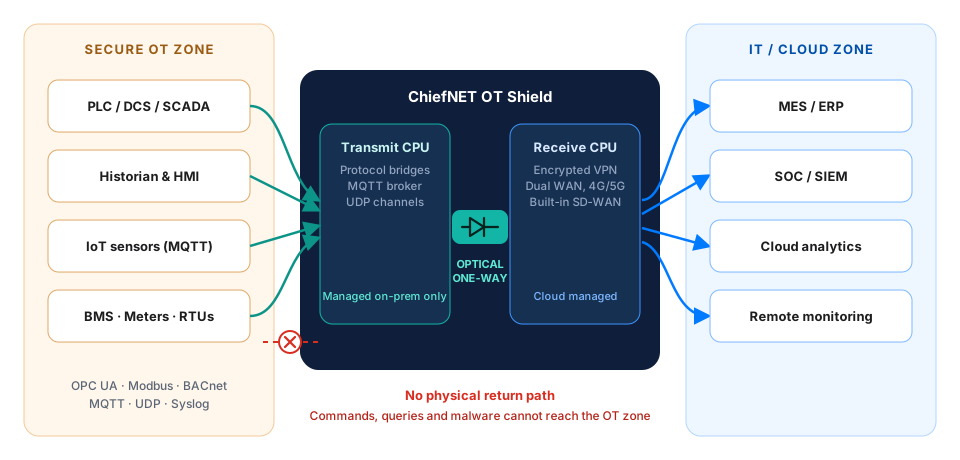
ChiefNET OT Shield: two isolated CPUs joined by an optical, one-way interface.
Physical design
A data diode is a physical hardware device that enforces one-way data flow, typically through optical or electrical isolation. A transmitter sits on the secure side and a receiver on the less secure side, and there is no physical mechanism for transmission in reverse.
Transmission mechanics
The diode carries logs, sensor outputs and other OT/ICS data to external monitoring or IT environments, and no command or data can return upstream. This protects critical systems from remote exploitation or manipulation.
Built-in security assurance
Unlike software firewalls, data diodes are immune to patching errors, configuration mistakes and malware intrusion. Penetrating the network behind one is nearly impossible without physical access to the device.
Advantages over firewalls
Data diode devices work at the hardware level and keep a physical air gap between security zones. Firewalls are software-based, need frequent updates and patches, and are more exposed to external attack. Because data flows only one way through a diode, it is nearly impossible to penetrate the network behind it without physical access to the device.
Where data diodes are used
Highly critical infrastructure such as power grids, oil fields, manufacturing plants and defence establishments.
Key Features of ChiefNET OT Shield
- Physical and electrical separation: OT Shield keeps the source and destination networks physically and electrically separate, creating a closed, non-routable, one-way data transfer path.
- Enhanced security: with no external points of entry, intruders and malware cannot infiltrate the secure network.
- Hardware-enforced data diode: builds a physical air gap between networks and stops data flowing in the wrong direction.
- Secured data transfer: real-time OT/ICS data is carried to a remote data centre or monitoring centre through an encrypted VPN tunnel.
- Protocol support: UDP traffic (broadcast, multicast, anycast), plus MQTT, OPC UA and TFTP (with additional software). Optional built-in OPC UA, BACnet and Modbus bridges.
- Orchestration and management: centralised, cloud-based orchestration and management, with zero-touch provisioning, pre-provisioning, whole-network monitoring, alerts and dashboards.
- Hardened OS: improves security and reduces the attack surface.
- Built-in SD-WAN: interconnects branches, factories and stores with the data centre or head office securely, while keeping the OT network isolated from the IT network.
OT Shield in a Hybrid Environment
On the receive side, OT Shield includes the same networking and management capabilities as the ChiefNET SD-WAN platform:
- Secure tunnels for enterprise traffic
- Link-quality monitoring, failover and load balancing
- Application QoS, traffic steering and fine-grained QoS
- Local and cloud Internet breakout, plus a cloud gateway
- Cloud-hosted controller and monitoring with a fully validated web UI
- Zero-touch provisioning and pre-provisioning
- Whole-network monitoring, alerts and dashboards
- Customer administrator and user authorisation levels
- Deployment at branches, HQ, colocation facilities and public clouds
Use Cases and Applications
- ICS protection: shields furnaces, compressors and other industrial control components from cyber intrusion.
- SCADA system security: blocks external threats while enabling safe, real-time data collection.
- Military deployment: keeps classified systems and data insulated from external threats.
- Remote IoT maintenance: enables safe diagnostics and updates without exposing OT endpoints.
- IP protection: prevents the theft of proprietary processes and industrial know-how.
- Legacy system safeguarding: protects outdated but essential systems from new vulnerabilities.
- Secure plant-to-plant communication: enables safe data exchange between geographically distributed facilities.
Advantages Over Traditional Firewalls
| Feature | ChiefNET OT Shield | Traditional firewalls |
|---|---|---|
| Data directionality | One-way (physical) | Two-way (software rules) |
| Update requirements | None (hardware enforced) | Frequent (software patches) |
| Configuration errors | Not applicable | Common |
| Resistance to cyberattacks | Near total (air-gapped) | Moderate to low |
| Suitable for critical OT | Yes | Not ideal |
Key Benefits
- Prevents cyber intrusions through the inbound path
- Supports regulatory compliance through hardware isolation
- Enables secure remote asset monitoring and predictive maintenance
- Supports digital transformation without compromising operational resilience
Conclusion
ChiefNET OT Shield is more than a cybersecurity enhancement: it is a different way to secure industrial communication. Its hardware-enforced, one-way protection lets organisations modernise monitoring and data flow without opening backdoors into critical OT environments. As cyber threats evolve, it protects the critical infrastructure organisations depend on.